I'll do a data-driven review of your actual electricity usage and tell you plainly whether switching to Wake Electric's Time-of-Use rate would save you money — or not.
I've spent over 15 years working directly inside the energy industry — analyzing interval data, evaluating utility rate structures, and working with Time-of-Use programs professionally. This isn't a tool I built to enter a market I don't understand. It's a service I built because I kept seeing the same thing: households paying more than they need to, simply because nobody ever ran the numbers for them.
When I give you a recommendation, it's backed by a decade and a half of this exact work — not a generic algorithm.
Four steps from sign-up to knowing exactly where you stand.
Log into Wake Electric's member portal and download your hourly usage CSV files. I'll walk you through exactly how to find them — it takes about 5 minutes.
Email your CSV files directly to me. That's it. No account setup, no app to install, no complicated steps.
I process your full year of hourly interval data — calculating exactly what you would have paid under the TOU rate vs. what you actually paid on the flat rate.
I send you a personalized visual report and a plain-English summary: switch or don't switch, here's what it means for your bill, and here's how to act on it if you choose to.
On-peak hours are just two hours a day. Whether those hours align with your household's routines is the entire question — and the answer is different for every home.
Your energy usage changes. Rates change. Your subscription means you're never flying blind — I'll re-run your analysis every year automatically.
A one-time analysis tells you where you stand today. But a lot can change in a year:
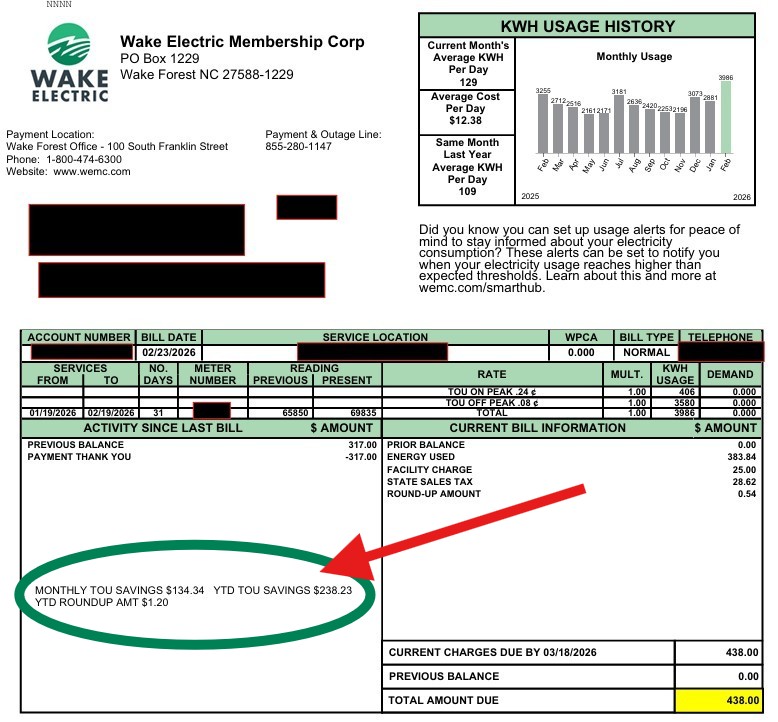
This is a real Wake Electric bill — with account details removed — showing TOU savings printed directly on the statement. That line is exactly what I surface for every customer I work with.
$134.34 saved in a single month. $238.23 saved year-to-date. No solar panels. No new appliances. No major lifestyle overhaul. Just the right rate plan matched to an existing usage pattern.
Your number could be higher, lower, or zero. But you won't know until someone actually looks at your data.
Find Out What I'd Save
Wake Electric's TOU rate charges 24.0¢/kWh during on-peak hours and just 8.0¢/kWh the rest of the time. Compare that to the standard flat rate of 13.0¢/kWh all day. If your heavy usage happens off-peak, you come out ahead.
In winter (Nov–Mar), on-peak is 6–8 AM. In summer (Apr–Oct), it's 4–6 PM. That's just two hours a day. Households whose routines keep them off-peak during those windows often see immediate savings without changing a thing.
Your smart meter records usage every hour. That granular history is what I use to model your exact bill under each rate — not estimates, not averages, but your actual usage recalculated against each pricing schedule.
TOU isn't a universal win. If your household runs heavy loads during peak windows, you may genuinely be better off on the flat rate. I run the real numbers and give you a straight answer either way.
If you're ready to get your analysis, head straight to the sign-up page → — it takes about two minutes.
If you have questions first, I'm happy to answer them. Use the form and I'll get back to you personally, usually within one business day.
Not sure if TOU is right for your household? Ask me.
Not sure how to pull your interval data from WEMC's portal? Ask me.
Questions about what the analysis covers or how it works? Ask me.
Straight answers — no sales pressure, no follow-up campaign.